

When Your Body Keeps the Score Before Your Mind Catches Up: Relationship Stress Signals Worth Investigating
Something feels off, but you cannot quite put it into words yet. Your stomach tightens before he walks through the door, your shoulders stay knotted through a quiet evening, and sleep slips away after arguments that were never fully resolved. These physical reactions are not random, and they are not weakness. Your body may be picking up on stress and tension in your relationship before your conscious mind has organized those experiences into a clear thought, and those signals are worth paying attention to.
The body may register stress before you can name it

Your stomach knots before he even walks in. Your shoulders tighten during an evening that looks, on the surface, perfectly calm. Your heart picks up speed when you see his name on your phone screen. These are not invented sensations, and they are not signs that something is wrong with you.
Stress affects the body in measurable ways. Research from the National Center for Complementary and Integrative Health shows that stress can increase heart rate, breathing rate, blood pressure, and muscle tension, and that long-term stress may contribute to digestive problems, headaches, sleep disorders, anxiety, and depression. The National Institute of Mental Health notes that stress and anxiety can show up as stomachaches, trouble sleeping, fatigue, and persistent apprehension, sometimes even when there is no immediate external threat visible to you.
What these symptoms cannot do, on their own, is tell you exactly why your body is reacting or whether your partner is the source. Stress responses are real and important, but they are not a verdict. A racing heart before a familiar interaction is information worth noticing, not proof of anything final.
The shift worth making is not from dismissal to certainty. It is from dismissal to curious observation. Instead of telling yourself you are overreacting, you can ask: what is this feeling responding to, how often does it show up, and what is happening around me when it does? That question is a much kinder and more useful starting point than silence.
Interoception connects physical sensations with emotional meaning
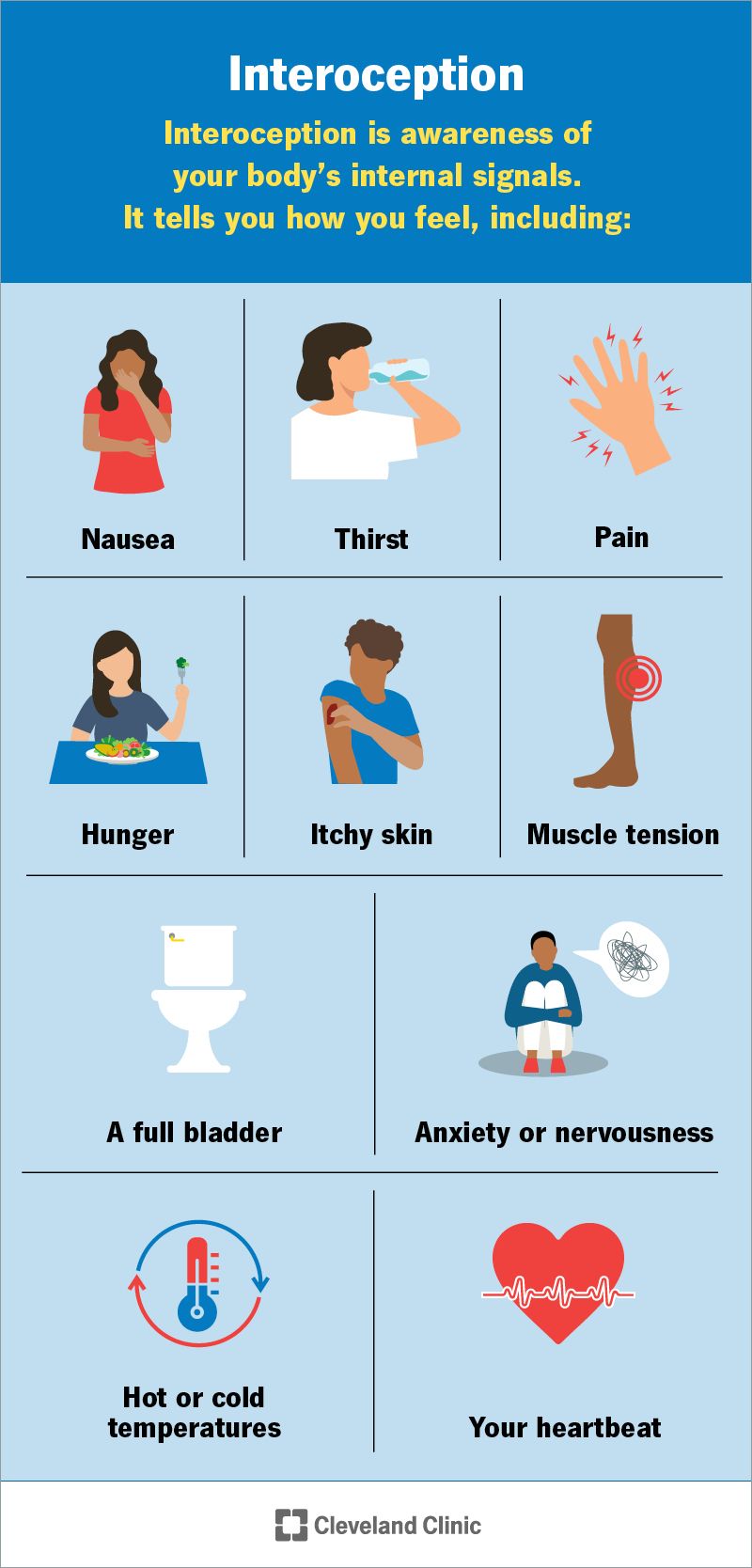
You walk into the living room and your chest feels heavy before a single word is spoken. You reach for your phone to answer a text and something in your gut tightens, even though nothing has happened yet. This is not imagination. There is a word for what is occurring: interoception.
Interoception means the sensing, attending to, and interpreting of signals that come from inside your body. Research on interoceptive mechanisms and emotional processing explains that emotional meaning does not arise from a bodily sensation alone. The brain also uses context, past experience, and appraisal to interpret what a physical feeling means. In other words, the nausea or the dread or the tightening in your chest is real, but the meaning your mind assigns to it is shaped by everything else you know and remember.
This is why an uneasy feeling can appear before you have consciously formed a thought about a situation. Your nervous system has been quietly collecting information, and the body reflects it before the words arrive. That early signal is worth honoring, not because it is infallible, but because it is asking you to pay attention.
What interoception cannot do is read another person’s intentions. The body responds to perceived threat and accumulated stress cues. It does not have direct access to what someone else is thinking, planning, or feeling. So when you notice that familiar tightening before a conversation you have learned to dread, you are picking up on something real about your own experience.
The next step is to look carefully at the pattern around that feeling, not to accept the sensation alone as a completed verdict.
Patterns and context matter more than one anxious moment

One sleepless night after a hard conversation proves nothing on its own. Everyone has those. What becomes meaningful is when you start noticing that the sleeplessness follows the same kind of argument, that your stomach settles when he is traveling, that your shoulders unknot the moment you walk into a friend’s house. Repetition and timing are where the real information lives.
Longitudinal research on couples and sleep found that destructive and psychologically aggressive conflict is associated with shorter sleep duration, lower sleep efficiency, and longer time to fall asleep. That connection is real and worth knowing. And the relationship runs in both directions: sleep deprivation can also increase emotional reactivity and make conflict more likely the next day, as preliminary research on sleep loss and interpersonal conflict suggests. A single symptom cannot tell you which came first.
Context is also essential because the same physical symptoms can show up in many different situations. Anxiety, work pressure, financial strain, and grief all affect sleep and digestion. What matters is whether the symptoms follow a recognizable pattern connected to specific interactions, and whether they ease when the source of tension is absent.
A gentle, non-diagnostic way to start noticing is to keep an informal record for a few weeks. Write down what happened, what was said or done, what your body felt, how long the feeling lasted, and whether it changed with rest, distance, or support. Research on interoceptive awareness and post-traumatic stress supports the value of attending carefully to internal signals within their full context, rather than in isolation. This exercise is not a test you can pass or fail.
It is simply a way of taking your own experience seriously enough to look at it clearly.
Look at what the partner repeatedly does

Physical sensations are one source of information. Observable behavior is another, and the two need to be read together. A sound interpretation of what is happening in a relationship requires looking at what actually occurs, repeatedly, over time, not just at how you feel in any given moment.
The National Domestic Violence Hotline describes emotional abuse as a pattern that can include controlling behavior, isolation from friends and family, intimidation, insults, humiliation, monitoring of movements or communications, threats, jealousy used as a justification for control, manipulation, dismissiveness, and pressuring someone to doubt their own memory or perception of events. These are not single bad days. They are repeated conduct that creates fear, erodes independence, or makes a person feel that they must constantly manage someone else’s reactions to stay safe.
Ordinary disagreement, incompatibility, and even occasional conflict are not the same as a pattern of coercion or control. All relationships have friction. Two people with different needs will sometimes argue, sometimes say things badly, sometimes hurt each other without intending to. What distinguishes relational distress from abusive conduct is the repetition, the intent to control or diminish, and the effect on your sense of safety and autonomy.
Ask yourself whether you regularly anticipate punishment after speaking honestly. Ask whether you have gradually lost access to friends, money, or your own judgment. Ask whether apologies are followed by the same behavior again and again. CDC guidance on intimate partner violence recognizes psychological aggression as a form of harm with real health consequences, including effects on the nervous, digestive, and musculoskeletal systems.
The body symptoms you are noticing may be the accumulation of that repeated experience, not a single overreaction to a single bad night.
Treat an anxious body with compassion and careful inquiry

Before you decide what your body is telling you, it is worth asking what else might be contributing to how you feel. This is not a way of dismissing your experience. It is a way of being fair to yourself and to the full picture.
Anxiety, depression, prior trauma, hormonal changes, medication effects, illness, chronic sleep deprivation, financial pressure, and work stress can all produce physical symptoms that feel very similar to relationship-related distress. Medical guidance on stress and health notes that stress symptoms are nonspecific, meaning the same physical reaction can arise from many different sources. That does not make the feeling less real. It means the feeling deserves careful attention rather than a quick explanation in either direction.
Prior trauma deserves particular gentleness here. Clinical literature on trauma assessment explains that people who have experienced earlier harm may become more vigilant toward cues that resemble past danger. That heightened awareness is a protective response, not a character flaw. But it also means that sometimes the nervous system responds to echoes of old situations rather than direct current threat, and that distinction matters when you are trying to understand what is happening now.
Research on anxiety and attention to threat shows that anxious states can increase sensitivity to perceived danger, producing both accurate caution and, at times, false alarms. Neither of these outcomes means you are irrational. Both mean you deserve support in sorting out what is yours and what is genuinely coming from the relationship around you.
The balanced standard is this: honor the bodily response, investigate its context, compare it honestly with observable conduct, and notice whether the same feelings arise in other stressful settings or only in this one. That is not doubt. That is precision.
Take symptoms seriously through medical care and safety planning

Physical symptoms are not something to explain away, whatever their source. If you have been experiencing new, persistent, severe, unusual, or worsening symptoms, a medical evaluation is the right next step, full stop. Clinical guidance on patients with multiple somatic symptoms is clear that physical complaints should not be dismissed simply because stress or psychological factors may be involved. The body produces real symptoms for real reasons, and those reasons deserve a real examination.
MedlinePlus guidance on fatigue advises contacting a health professional for ongoing exhaustion that does not improve with rest, and guidance on abdominal pain recommends evaluation for severe or persistent stomach pain, unexplained weight loss, difficulty breathing, blood in vomit or stool, or any symptom that is worsening over time. These are not thresholds you should try to push past alone.
If your relationship includes threats, stalking, coercive control, weapons, strangulation, escalating violence, threats involving children or pets, or a genuine fear of what will happen if you speak up or leave, the practical guidance shifts. That situation calls for confidential, individualized safety planning rather than a direct conversation with your partner.
Leaving an abusive relationship is not simply a matter of deciding to go. The National Domestic Violence Hotline warns that leaving can increase danger in some abusive relationships and recommends planning that accounts for your specific circumstances. The Hotline also emphasizes that money, housing, health, legal protection, and fear of retaliation are real barriers, not excuses. Anyone who suggests that leaving is simple has not reckoned with what safety actually requires.
The Hotline is available 24 hours a day at 1-800-799-7233, by text at 88788, and by online chat at thehotline.org. You do not have to be certain about what is happening to reach out. Uncertainty is a perfectly valid reason to call.
Self-trust means investigating the signal, not proving a verdict

Self-trust is not the same as certainty. It does not mean deciding, once and for all, that your partner is dangerous based on a feeling in your chest. It means taking your recurring sensations seriously enough to investigate them, seek medical care, observe patterns, and reach for support, rather than spending another year convincing yourself that nothing is wrong.
You are allowed to stop minimizing what your body keeps telling you. You are allowed to write things down, to notice what changes when distance enters the picture, to ask a doctor about symptoms that have lingered too long, and to call a confidential line if the relationship has crossed into territory that frightens you. None of that requires having proof. It only requires deciding that your experience is worth examining.
The body offers information, not verdicts. And you, finally paying attention to that information, are not overreacting. You are doing exactly what someone who deserves care and clarity would do.