

What He Really Means When He Says All His Exes Were Crazy
You have probably heard it before, maybe on a first date, maybe months into something that felt real: “All my exes were crazy.” Something about it lands wrong, even if you cannot name exactly why. That quiet unease deserves your attention, not because the phrase proves anything definite about him, but because what comes next, how he talks, listens, and handles conflict, tells you far more than four words ever could.
The phrase has no single hidden meaning

Hearing a man describe every woman he has ever dated as “crazy” can stop you mid-sentence. Your gut tightens, and you are not sure whether you are overreacting or picking up on something real. Both possibilities deserve space, because the phrase genuinely does not carry one fixed meaning, no matter how many articles promise to decode it for you.
He might be reaching for an imprecise word to describe a breakup that still hurts. He might be describing a former partner who genuinely threatened, stalked, or frightened him. He might be avoiding any honest look at his own role by attaching a single dismissive label to every woman who got close enough to see his flaws. Or he might simply have poor vocabulary for emotional pain.
Psychology Today’s analysis of this phrase notes that while it can signal blame-shifting or contempt, it is not diagnostic evidence of anything on its own.
“Crazy” is also not a clinical term. APA guidance on mental-health stigma points out that vague labels like this can pathologize ordinary anger, grief, or reasonable objections, and can erase the real possibility that the person using the word contributed to the very chaos he is describing.
Treat the phrase as a prompt, not a verdict. What matters is not whether the sentence reveals his hidden character in an instant. What matters is what you observe in the weeks and months that follow, in how he handles complexity, accountability, and the ordinary friction of two people actually trying to know each other.
Ask for conduct instead of accepting a label

Labels tell you almost nothing useful. “She was crazy” gives you no information about what actually happened between two people. Specific conduct, on the other hand, tells you a great deal about both the person being described and the person doing the describing.
You do not need to interrogate him or put him on trial. A few natural, curious questions can shift the conversation from a stigmatizing label to something you can actually evaluate. Try asking what specifically happened, what he did when things became difficult, what his ex might say he contributed to the breakup, or what he took away from that relationship. These are not trick questions.
They are the kind of questions any thoughtful person might ask when getting to know someone’s history.
Notice the difference between “she threatened to call the police every time we argued” and “she was just completely irrational.” The first is a concrete description of conduct you can weigh. The second is a character dismissal that leaves you with nothing to examine. If he experienced genuine mistreatment, stalking, harassment, or threats, he should be able to name those behaviors. The U.S.
Department of Justice defines stalking through specific repeated behaviors that cause fear, not through personality judgments. Precise language protects both people in the conversation.
Asking for specifics also protects against a subtler risk. The word “crazy” can be used to dismiss someone’s anger, grief, trauma response, or perfectly reasonable objection by making it sound like a symptom rather than a reaction. When he uses behavior-based language instead, you can assess the situation without pathologizing an absent person or accepting a one-sided verdict about her mental health.
Accountability matters without blaming abuse survivors

Repeated relationship conflict does not automatically mean one person is always the problem. Relationships are complicated, and most breakdowns involve some combination of incompatibility, poor timing, avoidance, or mutual patterns that neither person fully understood while they were inside them. The meaningful signal is not that every ex was imperfect. Most people’s exes were imperfect.
The meaningful signal is whether he can identify anything he contributed, learned, or would do differently.
A healthier account might sound like: “We brought out the worst in each other and I stayed longer than I should have,” or “I avoided hard conversations until things exploded.” These answers do not require him to accept blame for someone else’s abusive behavior. Accountability and victim status are not opposites. If a former partner threatened him, stalked him, or used coercion or violence against him, he is not responsible for those choices. Responsibility for abuse belongs to the person choosing it.
Research on distortion and intimate partner conflict finds that people who consistently escalate blame and rationalize their own behavior while minimizing their partner’s experience tend to repeat that pattern. The concern is not that he had difficult relationships. The concern rises when every story ends the same way: he was entirely without fault, she was entirely the cause, and there is nothing he would examine or change.
A systematic review on denial and blame in intimate partner abuse found that denial, minimization, and blaming are common features of accounts given by people who harmed their partners, but the existence of blame-shifting in abuse does not mean every person who criticizes an ex has been abusive. What you are listening for is a complete and permanent absence of self-reflection, not a single defensive moment.
Watch how he handles ordinary disagreement

His stories about the past matter less than what you can see right now. The most useful information you will get is not from how he describes women he dated three years ago. It comes from how he responds when you bring up something small that bothered you, when you disagree with his plan, or when you need to circle back to a conversation he would rather close.
The Gottman Institute distinguishes between a specific complaint and a character attack. Their research on the Four Horsemen identifies criticism, contempt, defensiveness, and stonewalling as destructive conflict patterns. Criticism attacks who someone is rather than addressing what they did. Contempt communicates disgust or superiority.
Defensiveness deflects accountability by turning the complaint back on the person who raised it. Stonewalling shuts the conversation down entirely. None of these patterns are comfortable, but their presence alone does not establish abuse.
People can become defensive under stress, shame, fear, or grief. A single defensive reaction during an argument about something vulnerable is not a red flag on its own. The pattern that deserves your attention is persistent defensiveness that never resolves, blame that always ends up back on you, contempt that makes you feel small for raising a concern, and conversations that never get repaired.
Gottman’s work on repair attempts emphasizes that the ability to calm down, return to the issue, acknowledge impact, and make genuine changes is more predictive of a relationship’s health than the conflict itself. A man who can argue and then come back, acknowledge your experience, and adjust his behavior is showing you something important. A man who argues, reverses blame, and then acts as though the conversation never happened is also showing you something important.
Abuse appears in a pattern of behavior
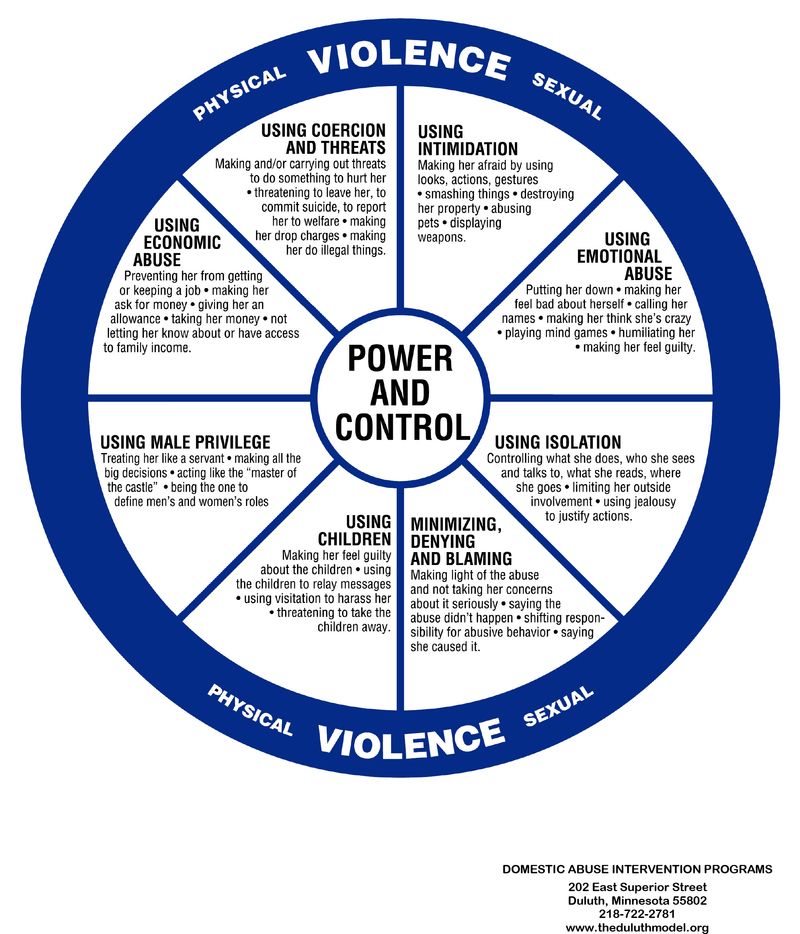
There is a real difference between a man who uses an imprecise word and a man whose behavior, over time, makes you smaller, more cautious, and less certain of your own perceptions. The word “crazy” is not what you are watching for. You are watching for what he actually does.
The CDC defines intimate partner violence to include psychological aggression: behaviors intended to harm someone mentally or emotionally or to exert control. That includes insulting, humiliating, threatening, intimidating, and controlling a partner. These are not personality traits. They are specific, observable actions with specific, observable effects on you.
The National Domestic Violence Hotline’s guidance on emotional abuse includes name-calling, humiliation, extreme jealousy, discouraging or blocking contact with friends or family, controlling finances or daily decisions, sexual pressure, threats, intimidation, property destruction, and blaming a partner for his own behavior. The Hotline notes that even one or two of these behaviors can be worth taking seriously, though context, severity, and repetition all matter.
Unhealthy conflict and abuse are not the same category, and it matters that you keep them separate. Two people who fight badly, interrupt each other, or go silent for a day are having a conflict problem. A sustained pattern of coercion, fear, monitoring, isolation, humiliation, or control is something different, and it requires a different kind of response. Conflict problems can often be worked through.
Coercive control is about power over you, and it does not improve with more patience or better communication on your part.
Watch for the cumulative effect. If you find yourself editing what you say, avoiding certain topics, checking his mood before speaking, or feeling afraid of his reaction to ordinary requests, those experiences are worth paying attention to, regardless of what word he uses for the women he dated before you.
You can track patterns without staging a test

You do not need to provoke an argument, set a dramatic boundary to see how he reacts, or engineer a confrontation to confirm what you are noticing. Deliberately provoking someone who may already be controlling or volatile can increase danger rather than give you clarity. What you can do is pay close attention to what is already happening.
Notice whether he answers reasonable questions calmly or becomes immediately defensive. Notice whether his account of events stays consistent over time or shifts when it becomes inconvenient. Notice whether he can sit with complexity, acknowledge your point even when he disagrees, and change his behavior after you raise a concern. These are not tests.
They are ordinary interactions that reveal ordinary patterns.
If you have started questioning your own memory or reality, that is worth taking seriously. The Hotline describes gaslighting not as a single disputed memory but as a broader pattern of denying events, insisting things did not happen, dismissing your concerns, and undermining your sense of what is real. One factual disagreement is not automatically gaslighting. A consistent pattern of being made to feel that your perceptions are wrong, excessive, or evidence of your own instability is something different.
If you want a concrete tool, keep a private record: dates, exact words, specific incidents, threats, restrictions, monitoring, or moments that left you feeling afraid or confused. Write down what happened, not your interpretation of it. The Hotline’s safety planning tool is designed for private use and includes a quick-exit feature. Do not store written notes anywhere an unsafe partner can access them, including shared accounts, devices he uses, or locations he can reach.
Choose safety over proving what the phrase means

You do not need to figure out whether an ex you have never met was actually “crazy.” You do not need a confession, an admission, or proof that you were right about what you sensed. What you need is a clear picture of what you are experiencing and a plan that keeps you safe while you decide what to do with that information.
If what you are seeing includes threats, escalating control, physical intimidation, monitoring of your phone or location, isolation from people you trust, or any incident that made you afraid, please reach out for confidential support before making any sudden moves. The Hotline’s guidance on escalation is clear that abuse can intensify when an abusive partner feels his control is threatened, and their resource on leaving an abusive relationship specifically warns that leaving can increase danger rather than end it. An impulsive exit without a plan is not always the safest option.
In the United States, you can reach the National Domestic Violence Hotline at 800-799-SAFE (7233), text START to 88788, or use their online chat. If you are in immediate danger, call 911. Be aware that internet use and phone activity may be monitored if you are in an unsafe situation. The Hotline’s safety planning tool is built with a quick-exit button for exactly this reason.
Your safety and your sense of reality both matter more than settling an argument about his past. The phrase “all my exes were crazy” is a beginning, not an ending. What he does next, and what you feel as a result, is where the real answer lives.