

One Day You Meet Someone Who Feels Like Peace Instead of Uncertainty
Most of us have spent years learning to read the silences, brace for the moods, and decode what someone really meant. You got so good at managing the unpredictability that calm, when it finally arrived, felt almost suspicious. Meeting someone whose words and actions line up, who shows up the same way on a Tuesday as they did on your first date, can feel quietly revolutionary. This is what that shift looks like, why it matters, and how to tell the difference between genuine emotional safety and a feeling that still needs to be tested against real behavior.
Peace begins when care no longer feels like a puzzle

Picture a Sunday morning when you send a text and simply wait, without rehearsing how to soften the message or preparing for an unpredictable reply. That small absence of dread is not nothing. For women who have spent months or years calibrating their words to avoid an eruption, a relationship where that vigilance is no longer necessary can feel almost disorienting at first.
Researchers describe this experience through a concept called perceived partner responsiveness, which means believing that your partner genuinely understands you, cares about your wellbeing, and appreciates who you are. Longitudinal research following more than 2,000 married adults found that higher levels of perceived responsiveness were associated with later gains in eudaimonic wellbeing, which includes a sense of personal growth, purpose, and self-acceptance. The effects were real but modest, and they did not apply equally to every measure of wellbeing, so this is not a promise of permanent happiness. What it does suggest is that feeling genuinely seen and cared for has a meaningful effect on how you experience yourself over time.
Peace, in this sense, is not a destination or a sign that you have found a soulmate. Healthy relationship guidance frames it as something far more practical: the ability to express concerns without fear, to have your boundaries respected, and to trust that the person in front of you behaves consistently whether or not you are watching.
Peace is not the absence of all difficulty. It is the presence of someone whose actions match their words, day after ordinary day. That alignment is what makes care feel like care instead of a puzzle you are always one wrong move away from losing.
Your body may soften, but calm cannot certify another person

There is a particular physical shift that happens when anxiety lifts in a relationship. You stop checking your phone every few minutes. Your shoulders drop. You can finish a meal without a quiet hum of worry underneath it.
That softening is real, and it deserves to be noticed.
What it cannot do is certify that another person is safe, honest, or permanently trustworthy. Your body is giving you information about your current experience, and that information matters. But calm has limits as evidence. Some people feel calm because they have gone emotionally numb, because they are avoiding conflict, or because controlling behavior has not yet become visible.
Research on trauma and its interpersonal effects describes how past abuse or chronic stress can alter the way a person reads safety cues, sometimes producing hypervigilance, which means staying braced for danger even when none is present, and sometimes producing numbness or avoidance, where the emotional alarm system goes quiet even when it probably should not.
Dissociation, another term worth naming plainly, is when you feel disconnected from your own feelings or body, sometimes as a way of managing overwhelming situations. Studies on trauma-related responses confirm that these patterns can persist even after a dangerous relationship has ended, which means anxiety around a respectful partner is not automatic proof that something is wrong, and calm around a harmful one is not automatic proof that everything is fine.
Notice how you feel, and then look at what the person actually does, repeatedly, over time. Research on interoception and self-awareness supports treating bodily signals as meaningful starting points for reflection, not as final verdicts. Your feelings are a clue. Consistent behavior is the evidence.
Consistency speaks louder than romantic intensity
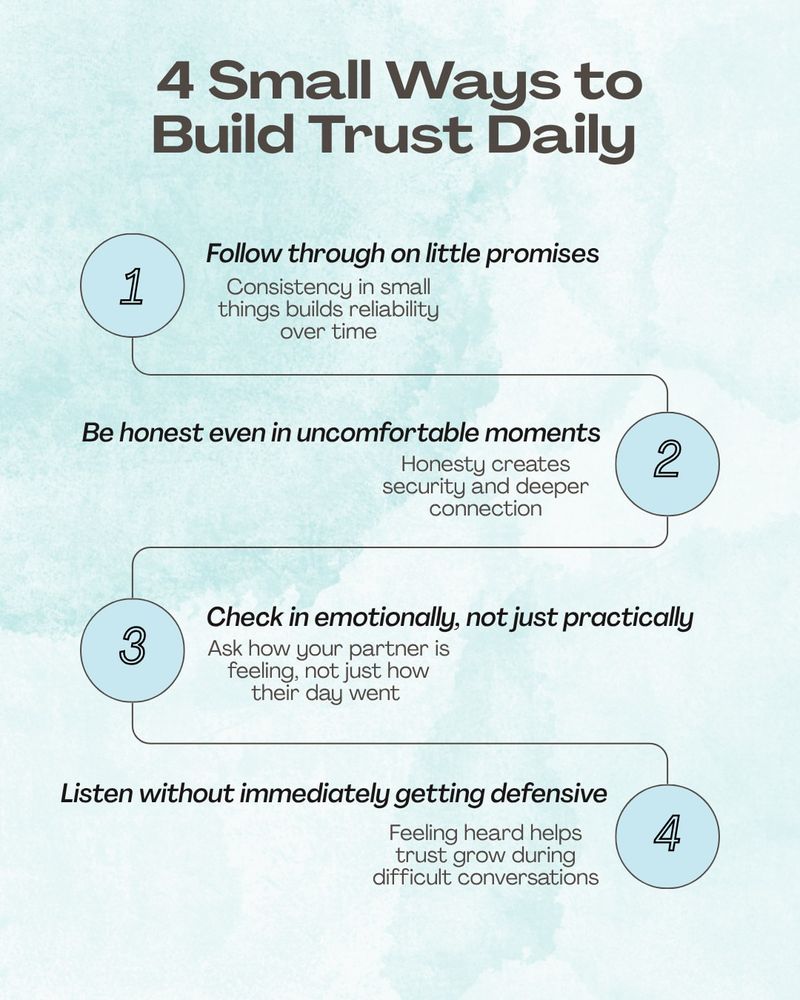
He remembered what you said about your sister’s health scare three weeks later and asked how she was doing. He said he would call at seven and called at seven. When he made a mistake, he named it without being pushed. None of this is cinematic, and that is exactly the point.
Reliability, follow-through, and the willingness to repair harm are stronger markers of safety than any grand gesture, declaration, or early rush of chemistry. Research on perceived partner responsiveness ties the sense of being genuinely cared for to patterns of consistent understanding and appreciation, not to intensity or frequency of romantic performance. Accountability over months tells you more than a single unforgettable weekend.
This matters especially because some patterns that feel intensely romantic at the start can later become controlling. The National Domestic Violence Hotline describes love bombing as excessive flattery, gifts, or affection that may later be used as leverage, a way of creating obligation before the relationship has had time to develop honestly. It can feel intoxicating precisely because it floods you with attention before you have had the chance to observe how a person behaves when things are ordinary, inconvenient, or uncomfortable.
Stable care may feel less dramatic than unpredictable attention for some people, particularly those who learned to associate intensity with love. Research on attachment and relationship patterns suggests that early relational experiences shape what feels familiar, though this is not universal and does not mean that every calm relationship is healthy or every passionate one is harmful. What you are watching for is whether the warmth holds when the spotlight goes off.
The clearest test arrives when you say no

You cancel plans because you need a quiet evening alone. You keep your standing dinner with your closest friend even though he would prefer you stayed home. You say you are not in the mood and do not offer an explanation beyond that. What happens next tells you more about this relationship than almost anything else.
A person who treats your autonomy as something to be respected, rather than a problem to be managed, can feel disappointment without turning it into punishment. They might say they are disappointed. They might need a few minutes. Healthy relationship guidance on boundaries is clear that your right to say no, to maintain friendships, to make independent decisions, and to have privacy is not a test of your loyalty.
It is a basic condition of being a whole person inside a relationship.
University health resources on healthy relationships emphasize that partners in a respectful dynamic share decision-making, support each other’s independence, and do not use guilt, silence, or withdrawal to pressure compliance. Additional guidance frames equality and mutual respect as foundational, not optional extras that disappear when one person is inconvenienced.
Saying no is not a relationship test you have to perform perfectly. It is just a boundary, and watching what happens to it will show you whether you are genuinely free or just being given the illusion of it. A partner who monitors whom you see, tracks your location without agreement, or treats your independence as betrayal is not experiencing disappointment. That is control, and it is worth naming it clearly to yourself even if you are not yet ready to name it aloud.
A peaceful relationship still has hard conversations

The fantasy version of peace has no friction. Nobody is ever tired, money is never tight, and nobody ever says something that lands the wrong way. Real peace looks completely different. It looks like bringing up the thing you have been avoiding and having the conversation feel hard but not terrifying.
Healthy relationship frameworks consistently describe conflict as a normal part of partnership, not evidence that something is broken. The distinction that matters is whether disagreements are handled with honesty, active listening, and accountability, or with insults, threats, contempt, punishment, and fear. UC Davis relationship health guidance puts it plainly: healthy relationships involve the ability to work through disagreements without one person being made to feel small, afraid, or controlled.
Research on couple stress and health outcomes links prolonged conflict and emotional hostility to psychological and physical strain over time, which is part of why chronic uncertainty in a relationship is genuinely exhausting, not just emotionally uncomfortable. A partner who responds to your hurt feelings by listening, acknowledging what happened, and trying to repair it is doing something meaningful. A partner who responds by turning the argument around, going silent for days, or making you feel foolish for raising it is doing something else entirely.
Even a caring, well-intentioned partner can say something that activates an old wound. That is not a sign that the relationship is unsafe. What matters is what comes next: whether the person can hear that they caused hurt, take it seriously without becoming defensive or retaliatory, and move toward repair rather than away from accountability. Relationship health resources name repair and accountability as core features of mutual respect, not occasional bonuses.
When uncertainty becomes danger, romance must give way to safety

Ordinary relationship uncertainty looks like not knowing whether your different communication styles will work long-term, or wondering whether you want the same things. That kind of uncertainty can be talked through, worked on, or honestly assessed over time. A different kind of uncertainty feels like walking on glass, monitoring a partner’s mood before speaking, or bracing for what happens if you say the wrong thing.
The CDC defines psychological aggression as communication intended to harm a partner emotionally or to exert control. In everyday terms, this includes persistent insults, humiliation, threats, isolation from friends or family, monitoring your phone or location without your agreement, and presenting false information to make you doubt your own memory or perception, which is what gaslighting means when you strip away the label and describe what it actually does to a person. CDC communication resources on intimate partner violence note that the boundary between psychological aggression and psychological abuse is not always sharply defined, but the pattern and its effects on you are real regardless of how it is categorized.
If a relationship includes threats, stalking, sexual pressure, physical violence, weapons, monitoring, escalating control, or strangulation, the conversation shifts from romantic interpretation to safety. The National Domestic Violence Hotline is clear that emotional abuse can coexist with physical violence and that escalation is a serious concern, particularly when a partner feels their control is slipping. Hotline guidance on escalation specifically cautions that separation or the perception of losing control can increase danger, which is why announcing an immediate departure or confronting a controlling partner is not universally safe advice.
If any of this is your situation, please reach out confidentially. The Hotline’s emotional safety planning resources encourage confiding in a trusted person, keeping private records of incidents where it is safe to do so, and maintaining access to identification, money, medications, and important documents. A trained advocate can help you build a plan that fits your specific circumstances, because safety planning is not one-size-fits-all. The National Domestic Violence Hotline is available at 1-800-799-7233, by text at 88788, and online at thehotline.org.
You can recognize peace without making love responsible for your healing

Something shifts when you stop waiting for a relationship to fix the part of you that still flinches. A supportive partner can contribute meaningfully to your sense of wellbeing, and research on perceived partner responsiveness does show associations between feeling genuinely cared for and greater personal growth and purpose over time. But one relationship, however kind, cannot become the sole source of your recovery, your certainty, or your self-worth.
Friendships that do not require you to earn your place in them, therapy that gives you space to understand your own patterns, community that holds you when a relationship cannot, financial independence that means your choices are actually choices: these are not backup plans. Emotional safety guidance from the Hotline names trusted support, small achievable steps, and self-kindness as foundations of safety and healing in their own right, not supplements to a romantic relationship.
You are allowed to want a partner who feels like peace. You are also allowed to be the primary source of your own stability. Those two things are not in conflict. Choosing peace in a relationship means trusting patterns over promises, holding your standards even when loneliness makes them feel like too much to ask, and refusing to carry chaos as the price of being loved.
You already know the difference between how it felt then and how it feels now. That knowledge belongs to you, not to whoever is standing next to you.