

I’d Rather Be Single Than Keep Shrinking Myself for an Emotionally Immature Man
Some women reach a point where they realize the relationship is still standing only because they keep holding it up. Every conversation adjusted, every need quietly shelved, every reaction softened so he does not shut down. That kind of exhaustion deserves to be named, not normalized. This article is for the woman who is starting to wonder whether staying is actually worth what it is costing her.
You are allowed to want love that does not require self-erasure

Picture the moment you decide not to bring something up. Not because it stopped mattering, but because you already know how it will go. He will get defensive, or go quiet, or find a way to make the problem about something you did. So you swallow it.
You pour the coffee, you keep the peace, and you carry it alone. That moment, repeated across weeks and months and years, is what this article is about.
Partnership is supposed to involve two people who show up for each other. Longitudinal research on new parents found that when a partner consistently fails to offer understanding, validation, and care, relationship satisfaction tends to decline over time. Responsiveness is not a luxury feature. It is one of the foundations that keeps a relationship from quietly hollowing out.
When one person does all the adjusting, that is not partnership. It is a performance of partnership that costs one person almost everything. Research on how couples recover after conflict suggests that repair patterns matter for long-term satisfaction and stability, which means a relationship where repair never really happens is not a neutral situation. It is a draining one.
This article does not argue that being single is always better than being in a relationship. What it does argue is this: you are not obligated to remain in a relationship that only continues because you keep making yourself smaller. Wanting love that leaves room for your actual self is not too much to ask. It is the minimum.
“Emotionally immature” describes a pattern, not a diagnosis

“Emotionally immature” is not a clinical label pulled from a diagnostic manual. It is plain language for a set of recurring behaviors that you can observe, name, and assess honestly without needing a psychology degree to do it.
The pattern tends to look like this: he becomes defensive the moment something is raised. He turns criticism back on you before the sentence is finished. He avoids conversations about anything emotionally uncomfortable, or he engages long enough to seem cooperative and then nothing changes. When something goes wrong between you, the responsibility for fixing it somehow lands in your lap.
Longitudinal research has linked demand-withdraw communication, where one partner pursues discussion and the other consistently avoids or shuts down, with declining relationship satisfaction over time.
He may also struggle to manage his own emotional state without leaning on you to stabilize him, yet remain unavailable when you need the same. Studies on emotion-regulation difficulties have connected them with withdrawal during conflict and lower relationship well-being. One hard conversation does not establish a pattern. Everybody has a bad week.
But when defensiveness, avoidance, and poor accountability repeat themselves across months, and when he consistently makes his emotional growth your responsibility, that is a pattern worth taking seriously.
The distinction matters because one difficult conversation is not a verdict, but a repeated pattern in which you are always the one adjusting and he is always the one being managed is a different situation entirely. You are allowed to call it what it is without diagnosing him, without being cruel, and without minimizing what it has cost you.
His withdrawal can turn your reasonable need into your exhausting burden

You bring something up carefully. You choose the right moment, the calm voice, the measured words. And he goes quiet. Or he leaves the room.
Or he says “I don’t want to fight” and treats that as a full response. The conversation is over before it began, except it is not really over for you. You are still carrying it.
This is the demand-withdraw dynamic in everyday life. One person tries to address something that matters, and the other consistently retreats. Research has associated this pattern with lower relationship satisfaction, and the effects compound over time. What starts as a frustrating communication habit can slowly become a structure in which your needs are treated as the problem and his discomfort is treated as the boundary.
Emotion-regulation difficulties are connected to this. When someone struggles to tolerate uncomfortable feelings, withdrawal can feel like the only option to them, even when it leaves you stranded mid-sentence. Studies linking emotion-regulation difficulties with conflict withdrawal make clear that this is not simply a personality quirk with no relational cost. The cost is real, and you are the one absorbing it.
There is a meaningful difference between a partner who needs twenty minutes to calm down and comes back to finish the conversation, and one who uses silence to end conversations permanently. A mutually agreed pause that returns to the issue is not the same as withdrawal used to avoid accountability, punish you for raising something, or make you feel that your needs are simply too much. The first is a coping strategy. The second is a pattern that teaches you to stop asking.
The real test is whether he repairs the harm after the promise
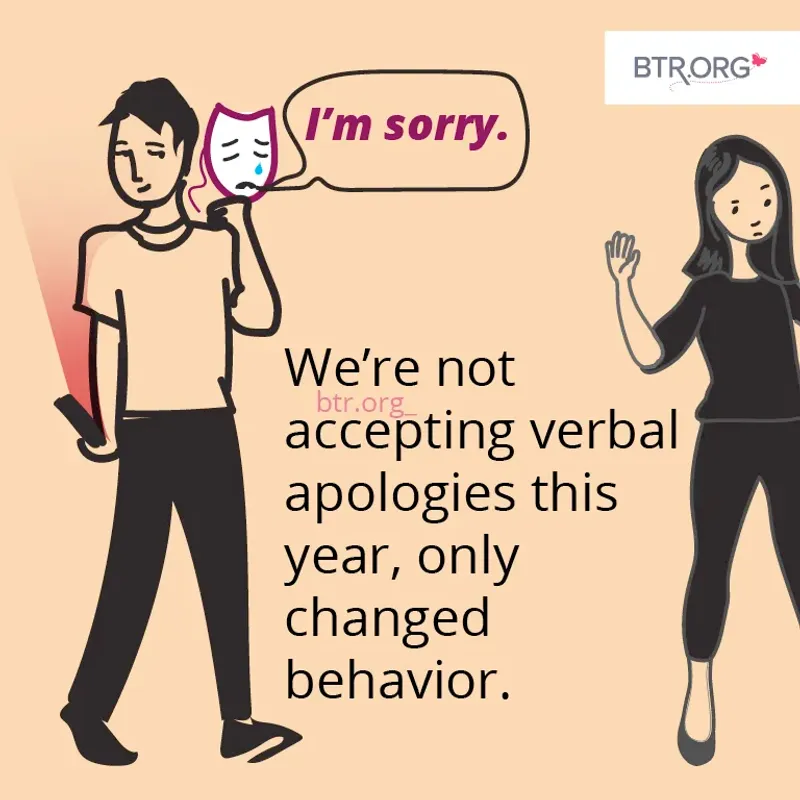
An apology is the easiest thing to offer and the easiest thing to withhold meaning from. He says he is sorry. He says it will be different. He may even seem genuinely remorseful for a day or two.
And then the same thing happens again, in the same way, with the same aftermath. After enough repetitions, the apology stops being a promise and starts being a reset button he presses so the conversation can end.
Repair is not the same as an apology. Real repair involves listening to what the harm actually was, acknowledging it without redirecting to his intentions or your tone, returning to the issue rather than waiting for it to dissolve, and then changing behavior consistently enough that the change becomes visible. Research on how couples recover after conflict has found that post-conflict repair patterns can predict both later satisfaction and relationship stability. How a couple comes back from a hard moment matters as much as how they argue.
Research has also linked constructive communication and emotion regulation with marital satisfaction, but that finding carries an important clarification. A study of middle-aged and older married couples found an association between a wife’s ability to communicate constructively and marital satisfaction. That does not mean you are responsible for fixing the relationship by staying calmer or phrasing things more carefully. The difference is between regulating yourself enough to communicate clearly and being expected to suppress legitimate concerns indefinitely while he does nothing.
Watch what he does after the storm, not what he says during it. A man who repairs harm consistently, acknowledges what he got wrong without turning it back on you, and changes his behavior over time is showing you something real. A man who apologizes and repeats is also showing you something real. Both are worth believing.
Healthy compromise leaves you recognizable to yourself

Compromise is not the problem. Every lasting relationship involves flexibility, adjusting expectations, and sometimes putting the other person first. The problem is when flexibility flows in one direction so consistently that you can no longer remember what your actual preferences are. You stopped mentioning the things that hurt.
You see fewer friends because it is easier than explaining where you were. You soften every opinion before it leaves your mouth.
When you call basic respect “too much to ask,” that is not compromise. That is self-erasure dressed up in patience. Relationship satisfaction does not exist in a vacuum. Research notes that stressors across different life stages can affect couples, and that relational well-being shifts over time.
A relationship that felt manageable at thirty may feel suffocating at forty-five, not because you changed unreasonably, but because the cumulative weight of carrying it finally became visible.
The version of you that exists inside a relationship that requires chronic self-silencing is a smaller version. You may have stopped noticing gradually, the way you stop noticing a background noise until it finally goes quiet. Perceived responsiveness from a partner, meaning feeling understood, valued, and cared for, is connected to how satisfied people feel in their relationships. A relationship where your needs are routinely unmet is not a neutral baseline.
It has a cost.
Choosing to be single rather than stay in a relationship that requires you to disappear is a legitimate decision, not a failure or a guarantee of happiness. Research acknowledges that social, financial, and emotional circumstances affect how and whether people leave. There is no judgment here for how long you stayed. The question worth sitting with is whether the woman in the mirror still feels like herself.
When immaturity becomes control, the question is no longer just compatibility

Emotional immaturity and emotional abuse are not the same thing. Someone can be avoidant, defensive, and poor at accountability without deliberately trying to control or harm a partner. The distinction matters, because the responses to each situation are different, and collapsing them does not help you assess what is actually happening in your relationship.
The shift from immaturity to something more serious tends to show up in specific behaviors. The National Domestic Violence Hotline identifies warning signs of emotional abuse that include name-calling, controlling your time and actions, isolating you from friends or family, questioning your memory or perception of events, withholding affection as punishment, threats, coercion, manipulation involving sex or suicide, and blaming you for his behavior. These are not communication problems. They are patterns of control.
If you feel like you are always walking on glass, always managing his mood to prevent something worse, always wondering what version of him you will get today, that feeling is information. A systematic review found that psychological violence, defined as behavior used to threaten, intimidate, belittle, control, or diminish a partner, is associated with adverse mental-health outcomes and may contribute to significant distress. The association does not require a dramatic incident to be real. Accumulated low-level control has a cost too.
You do not need to formally diagnose him to trust what your body already knows. The question is not whether he has a label. The question is whether the pattern you are living inside is safe, and whether it is sustainable for the person you are still trying to be.
If leaving could increase danger, support comes before a dramatic exit
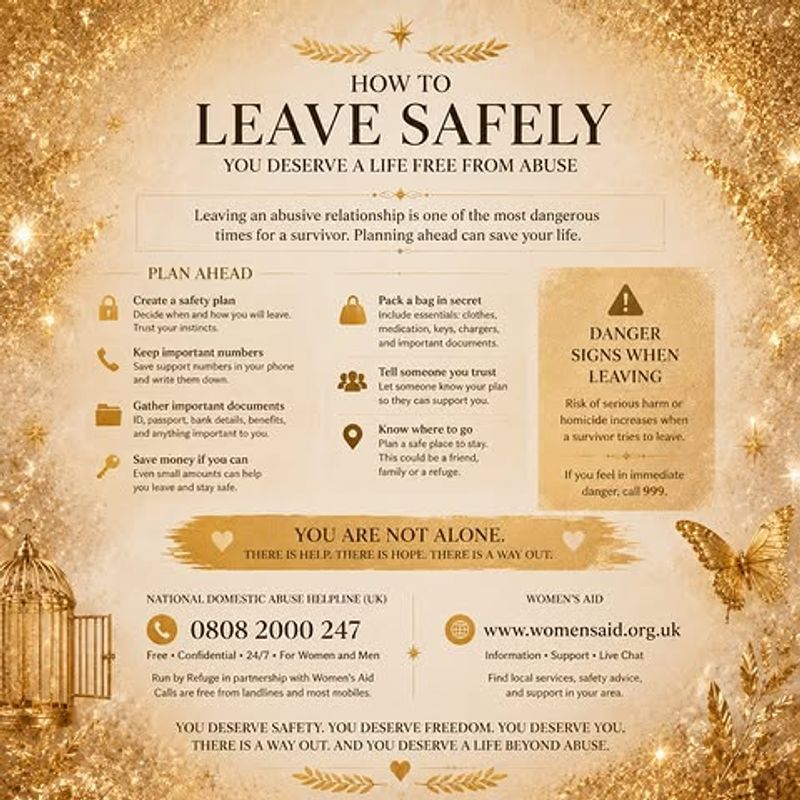
Leaving is not always the safest first move. When abuse, threats, financial dependence, children, housing insecurity, weapons, or stalking are part of the picture, an abrupt exit can escalate danger rather than end it. This is not a reason to stay forever. It is a reason to be strategic and to get support before making any visible move.
The Hotline notes that abuse may escalate when an abusive partner feels control slipping. Announcing that you are done, issuing an ultimatum, or confronting him with the full truth of how you see the relationship can increase risk rather than prompt accountability. The Hotline advises that confronting an abusive partner does not reliably produce change and can make things more dangerous. That is not a reflection of your strength or your honesty.
It is a safety reality.
If you are concerned about your safety, emotional safety planning is a practical starting point. It focuses on identifying trusted people, creating small layers of safety in daily life, and building toward a more individualized plan at a pace that accounts for your specific circumstances. Individual support from a domestic-violence-informed professional is a safer resource than couples counseling in these situations. The Hotline does not recommend couples counseling with an abusive partner because the unequal power dynamic can make disclosures unsafe and may allow what you share to be used against you later.
If persistent following, monitoring, unwanted contact, or surveillance is part of what you are experiencing, that may meet the definition of stalking. The U.S. Department of Justice defines stalking as a course of conduct directed at a specific person that would cause a reasonable person to fear for their safety or experience substantial emotional distress. Stalking-specific safety planning exists for this reason.
You can reach the National Domestic Violence Hotline at 1-800-799-7233, by texting START to 88788, or by chatting at thehotline.org. None of these contacts require you to have already decided to leave.
You do not have to become smaller to prove that love can work

A relationship that only survives because you carry it alone is not a partnership. It is a job you were never supposed to have and were never paid for. You are allowed to put it down.
Choosing peace, autonomy, and singlehood over a relationship that repeatedly asks you to disappear is not giving up on love. It is refusing to trade yourself for the appearance of it. Recovery after leaving a difficult relationship is not always immediate or linear. Research suggests that mental-health outcomes can improve after abusive relationships end, though the course varies and takes time.
Clarity may come in waves. That is allowed too.
You do not have to have it all figured out to know that the version of you who stopped talking, stopped asking, and stopped expecting anything is not who you actually are. The woman underneath all that quiet is still there. She has been waiting, with considerable patience, for you to remember that she does not have to earn her place in her own life.
A love worth staying for leaves you more yourself, not less. That is not a high standard. That is the standard.